

Healthcare Software: The Ultimate Guide to Transforming Patient Care
- James Colley
- Feb 22
- 11 min read

EHR, HIPAA, RPM… does the world of healthcare technology feel like a confusing alphabet soup? It’s easy to feel overwhelmed by the jargon, unsure how these digital tools truly connect to your personal health journey. Behind all these terms, however, is a simple, powerful goal: better care for you. The right healthcare software isn't just for clinics and hospitals; it's designed to make your path to wellness smoother, safer, and more supportive.
This guide is here to offer a clear, gentle path through the noise. We'll explore the essential types of software transforming patient care, from the electronic health records that keep your information secure to the compassionate AI-driven apps supporting mental wellness anytime, anywhere. You will discover how these modern tools solve real-world problems for both patients and providers, creating a more efficient, accessible, and deeply personal healthcare future. Let's begin this journey to clarity and empowerment together.
Key Takeaways
Understand the core software types, from EHRs to practice management tools, that form the foundation of modern patient care.
Learn how the focus is shifting to patient-centric apps that empower you to take an active role in your own health and wellbeing.
Discover the essential, non-negotiable features to look for when choosing the right healthcare software for a practice or organization.
See how AI is already being used in practical ways to create more personalized, supportive, and effective treatment plans.
Table of Contents What is Healthcare Software? A Foundation for Better Care The Core Pillars: Essential Types of Clinical & Practice Management Software The New Wave: Patient-Centric & Mental Health Software Critical Factors in Choosing Healthcare Software The Future is Now: AI's Growing Role in Healthcare Software
What is Healthcare Software? A Foundation for Better Care
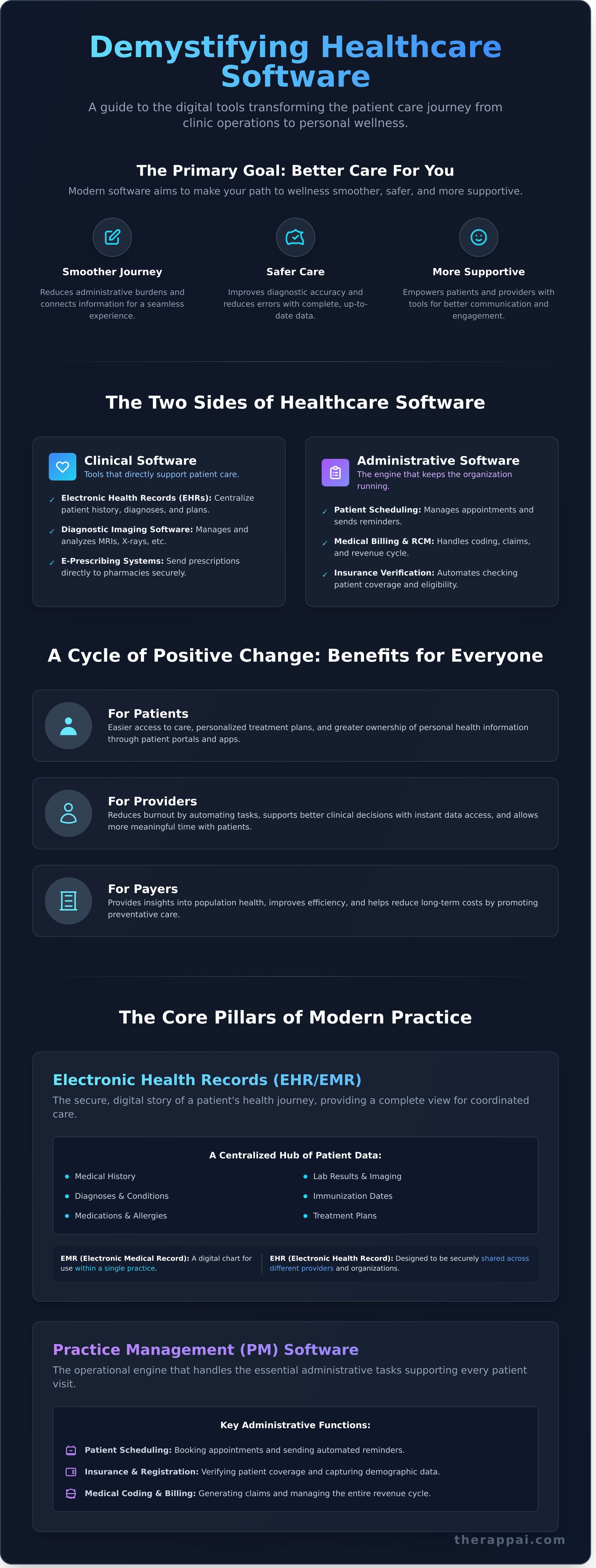
At its heart, healthcare software is a collection of digital tools designed to support and improve every aspect of a person's health journey. Think of it as the central nervous system of a modern clinic or hospital, connecting every part-from the front desk to the operating room-to work together seamlessly. Its primary goal is to enhance efficiency, improve diagnostic accuracy, and ultimately lead to better patient outcomes. This broad category of technology, which answers the core question of What is Healthcare Software?, is moving the industry away from disconnected paper files and toward a more integrated, responsive, and human-centered model of care.
To better understand the technologies shaping this transformation, this video offers a helpful overview:
This digital shift directly addresses long-standing challenges in the medical field. It breaks down information silos, where a patient's history might be trapped in one specialist's office. It reduces the immense administrative burden on clinicians, freeing them from paperwork to focus on patients. Most importantly, it helps close dangerous care gaps by ensuring every provider has a complete, up-to-date view of a patient's health, whether they are using software designed for clinicians or a patient-facing mobile app.
The Two Sides of the Coin: Clinical vs. Administrative Software
Healthcare technology generally falls into two key categories that must work in harmony for a seamless experience. One side focuses on care delivery, while the other manages the operational foundation.
Clinical Software: These are the tools that directly support patient care. Examples include Electronic Health Records (EHRs), diagnostic imaging software, and e-prescribing systems that guide medical decisions.
Administrative Software: This is the engine that keeps a healthcare organization running. It includes systems for patient scheduling, medical billing, and Revenue Cycle Management (RCM) that handle the business of care.
Why It Matters for Everyone: Patients, Providers, and Payers
The impact of well-designed healthcare software extends to every corner of the ecosystem, creating a cycle of positive change and support for all involved:
For Patients: It means easier access to care through online portals, more personalized treatment plans based on comprehensive data, and greater ownership of their own health information.
For Providers: It helps reduce burnout by automating routine tasks, supports better clinical decision-making with instant access to data, and allows for more meaningful, supportive time with patients.
For Payers: It provides valuable insights into population health trends, improves operational efficiency, and helps reduce long-term costs by promoting preventative care and better outcomes.
The Core Pillars: Essential Types of Clinical & Practice Management Software
Behind every smooth patient experience and successful clinical outcome is a set of foundational technologies. This core healthcare software acts as the central nervous system for a modern clinic or hospital, seamlessly connecting patient care with operational efficiency to create a supportive and reliable environment for everyone involved.
Electronic Health Records (EHR/EMR): The Digital Heart of Patient Data
Think of an Electronic Health Record (EHR) as the secure, digital story of a patient's health. It holds everything a care team needs in one place: medical history, diagnoses, medications, lab results, and treatment plans. This centralization empowers providers with a complete view of a person's health, reducing errors and fostering better-coordinated care. While often used interchangeably, an EMR (Electronic Medical Record) is typically a digital chart for a single practice, whereas an EHR is designed to be shared securely across different providers, creating a truly connected care journey.
Practice Management (PM) & Billing Software: The Operational Engine
If the EHR is the heart of clinical data, Practice Management (PM) software is the engine that keeps the facility running. This system handles the essential administrative tasks that support every patient visit, including:
Patient scheduling and appointment reminders
Insurance verification and registration
Medical coding and billing
Effective PM software is crucial for a practice's financial wellbeing. It streamlines Revenue Cycle Management (RCM), ensuring that services are billed correctly and payments are processed efficiently. For these systems to function properly, they must often meet standards guided by organizations like the federal entity for health IT, which helps ensure data security and interoperability.
Telehealth & Remote Patient Monitoring (RPM): Care Beyond Clinic Walls
Modern healthcare software extends care far beyond the physical walls of a clinic. Telehealth platforms provide a safe and convenient way for you to connect with your provider through video consultations and secure messaging. Taking this a step further, Remote Patient Monitoring (RPM) uses connected devices-like smart scales or blood pressure monitors-to track vital signs from home. This allows care teams to proactively manage chronic conditions, offering guidance and support before a health issue becomes critical and putting patients at the center of their own wellness journey.
The New Wave: Patient-Centric & Mental Health Software
The landscape of modern medicine is undergoing a profound and personal transformation. For years, the focus of healthcare software was on streamlining tasks for providers and administrators. Today, the new wave of technology places power, knowledge, and control directly into the hands of patients. Driven by the smartphone in your pocket, this shift prioritizes personal wellness, preventative care, and immediate accessibility, creating a more supportive and proactive healthcare journey for everyone.
Patient Portals and Engagement Platforms
These secure online platforms are your personal health command center. Gone are the days of waiting for a phone call for test results. Modern patient portals offer a suite of empowering features, including:
One-click appointment scheduling and management.
Instant access to lab results, medical history, and visit summaries.
Secure messaging directly with your care team.
A simple, intuitive user experience is essential, as it encourages you to take a more active and informed role in managing your health.
The Rise of Mental Health Technology
Addressing mental wellbeing is more critical than ever, and technology is rising to meet the need for accessible, stigma-free support. This specialized software fills gaps left by traditional therapy by offering immediate help, often anytime, anywhere. Tools range from guided meditation apps to platforms providing digital Cognitive Behavioral Therapy (CBT). Increasingly, sophisticated AI-driven platforms offer personalized support, reflecting AI's growing role in healthcare by making guidance more adaptive and responsive. These tools are also becoming a key part of corporate wellness programs, providing employees with confidential support whenever they need it.
Wellness Apps and Wearable Integrations
Preventative care now extends to your daily life through a vibrant ecosystem of wellness apps focused on fitness, nutrition, sleep, and mindfulness. The true power of these tools is unlocked when they integrate seamlessly with data from wearables like the Apple Watch, Oura Ring, or Fitbit. This connection provides a holistic, real-time view of your health, transforming raw data into actionable insights that help you build and maintain healthy habits for a better tomorrow.
Critical Factors in Choosing Healthcare Software
Selecting the right technology is more than a purchase; it’s a long-term investment in the wellbeing of your patients and the efficiency of your practice. The most powerful platform is useless if it isn't embraced by your team. To make a wise, future-proof choice, focus on the foundational pillars that ensure your new healthcare software becomes a supportive partner in care, not a frustrating obstacle.
Consider these non-negotiable factors as your guide:
Security and Compliance: The Trust Foundation
In healthcare, trust is everything. Robust security isn’t just a feature-it is the bedrock of your relationship with patients. Your software must be built on a framework of uncompromising compliance to protect sensitive personal health information. This includes:
HIPAA: The Health Insurance Portability and Accountability Act is the U.S. standard for protecting patient data privacy. Compliance is a legal and ethical must.
GDPR: For organizations serving individuals in the European Union, the General Data Protection Regulation sets a global benchmark for data rights and privacy.
SOC 2: This framework ensures a service provider securely manages data to protect the interests of your organization and the privacy of your patients.
Interoperability: Ensuring Systems Can Communicate
Imagine your different software systems trying to work together but speaking different languages. That’s a data silo. Interoperability is the solution-it’s the ability for diverse systems to seamlessly exchange and interpret shared data. This is vital for creating a single, unified view of a patient's journey, enabling coordinated care between departments or other providers and preventing dangerous information gaps.
User Experience (UX): Designing for Humans, Not Just Data
Technology should reduce burdens, not create them. An intuitive, clean user experience is critical for both clinicians and patients. A clunky, complicated interface leads directly to provider burnout and administrative fatigue. For patients, a confusing app or portal results in low adoption, missed appointments, and disengagement from their own care. Modern tools, like this AI therapy product, demonstrate this principle by prioritizing a seamless and supportive user journey from the very first interaction, ensuring the technology feels helpful and approachable.
Ultimately, the best healthcare software is the one that empowers people. By prioritizing these core principles, you can choose a solution that truly supports your mission to deliver exceptional care. To see how these principles are put into practice, explore tools designed with care at their core at therappai.com.
The Future is Now: AI's Growing Role in Healthcare Software
Artificial intelligence is no longer a futuristic concept; it is a present-day force actively reshaping patient care. While AI-powered diagnostics often grab headlines, its most significant impact is happening behind the scenes, making healthcare more predictive, personalized, and profoundly efficient. This evolution in healthcare software is arguably the most exciting development in the field, creating a more supportive and responsive system for everyone.
AI for Administrative Automation
One of AI's most immediate benefits is its ability to tackle the administrative burden that leads to clinician burnout. AI-powered tools now automate repetitive tasks like medical coding, voice-to-text transcription, and intelligent appointment scheduling. This automation frees up countless hours, allowing doctors, nurses, and support staff to redirect their focus from paperwork back to what truly matters: caring for their patients.
AI in Personalized Care and Treatment
AI excels at analyzing vast and complex datasets-from genomic information to lifestyle factors-to uncover patterns invisible to the human eye. This capability is ushering in an era of truly personalized medicine. Predictive analytics can identify patients at high risk for conditions like sepsis or heart disease, enabling early intervention. This data-driven approach allows for the creation of tailored treatment plans that are more effective and produce better outcomes.
AI as a Supportive Companion: The Emergence of AI Therapy
Perhaps the most personal application of AI is in mental wellness. AI-driven conversational agents are emerging as powerful tools to provide immediate emotional support. The key benefits are clear:
24/7 Availability: Support is there anytime, anywhere, without an appointment.
Anonymity: Creates a safe, non-judgmental space for users to open up.
Accessibility: Overcomes barriers of cost, stigma, and geography.
It’s important to see these tools as supportive companions designed to complement, not replace, human clinicians. This is where pioneers are realizing therappai's vision for the future of mental support-blending innovative technology with deep empathy to make mental wellbeing a part of daily life. As this technology matures, it promises to be a transformative component of modern healthcare software, offering a gentle guide toward a healthier mind.
The Future of Care is Personal and Accessible
The journey through modern medicine is increasingly powered by technology. From streamlining practice management to pioneering new diagnostic tools with AI, the landscape of healthcare software is fundamentally reshaping our approach to wellness. The most significant transformation is the shift towards patient-centric platforms that place control, convenience, and support directly into the hands of the individual. This evolution makes quality care more accessible than ever, especially in vital areas like mental health.
This new era of compassionate technology is here now. Therappai embodies this progress by providing a supportive, 24/7 AI video therapist right when you need it. Designed for both personal growth and workplace wellness, it creates a safe and approachable space on a secure, HIPAA, GDPR, and SOC 2 compliant platform. Your mental health can't wait, and with the right tools, it doesn't have to.
Take the first step towards better mental wellbeing. Explore Therappai today. Your journey to a healthier mind is a courageous one, and you don't have to walk it alone.
Frequently Asked Questions About Healthcare Software
What is the difference between EHR and EMR software?
Think of an Electronic Medical Record (EMR) as a digital version of a patient’s chart from a single practice. It tracks data over time within one office. An Electronic Health Record (EHR) is more comprehensive. It is designed to be shared securely with other providers, like specialists or hospitals, giving a complete picture of a patient's health journey. An EMR is a chapter, while an EHR is the entire book of a patient's care.
How does healthcare software ensure patient data is kept private and secure?
Protecting your information is the highest priority. Reputable healthcare software uses multiple layers of security, including end-to-end data encryption, to keep data safe both when stored and when transmitted. It also uses strict access controls, ensuring only authorized clinicians can view patient records. Regular security audits and compliance with standards like SOC 2 and GDPR help create a safe, trustworthy environment where patient privacy is always respected and defended against threats.
What is HIPAA compliance and why is it essential for healthcare software?
The Health Insurance Portability and Accountability Act (HIPAA) is a U.S. law that sets the standard for protecting sensitive patient health information. For software, being HIPAA compliant means implementing strict physical, technical, and administrative safeguards. This is essential because it builds a foundation of trust between patients and providers, ensuring personal health data is handled with the utmost care and confidentiality, and is protected from unauthorized access or breaches.
Can AI software replace doctors or therapists?
No, AI is designed to support and empower healthcare professionals, not replace them. AI tools can help with administrative tasks, analyze data to find patterns, or offer on-the-go support for mental wellbeing. However, the nuanced clinical judgment, empathy, and human connection that a doctor or therapist provides are irreplaceable. AI acts as a compassionate and powerful assistant, helping clinicians deliver more personalized and efficient care to every patient they guide.
How is healthcare software typically priced?
Pricing models can vary to fit different needs. Many platforms use a subscription model, often billed per provider, per month. Other systems may charge based on the number of patients or the specific features you need. For large health systems, pricing might include a one-time license fee plus ongoing maintenance costs. The goal is to find a clear, transparent pricing structure that aligns with your practice’s size, specialty, and budget for your chosen solution.
What is the biggest challenge in implementing new healthcare software?
The greatest challenge is often guiding your team through the change. Successfully introducing a new system requires thoughtful training and a shift in established daily workflows for doctors, nurses, and staff. Overcoming resistance to change and ensuring everyone feels comfortable and supported with the new technology is crucial. A smooth transition also depends on how well the new software integrates with your existing systems to avoid disrupting the flow of patient care.


Comments